What does the literature say, what does the data show?
In an effort to better understand the impacts of thermal & eutrophic conditions on trout fisheries, SWT & UMW commissioned the following:
A nutrient pollution impact evaluation on watersheds
A literature review on thermal thresholds and how Montana’s neighboring states in the rocky mountain west choose to manage their coldwater & native fisheries.
These documents, combined with our extensive data results, can help clarify how resource management policy & legislative decision making have real impacts on the health and sustainability of our treasured natural resources.
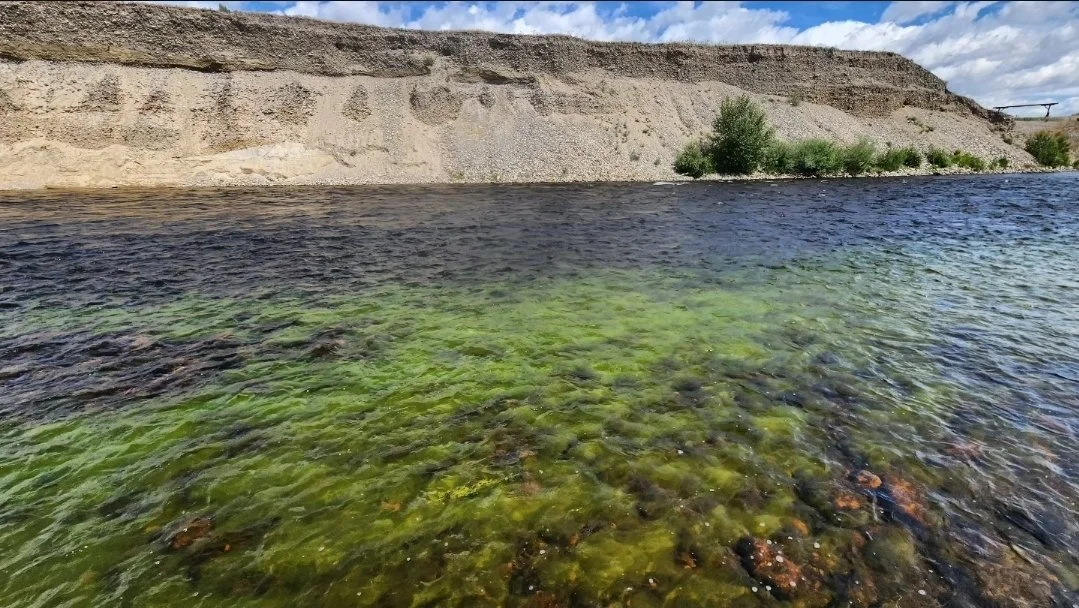
Algae bloom on the lower Big Hole River - June, 2025
Eutrophication - i.e. nutrient pollution
The most consequential development in southwest Montana water quality over the last five years has been the move of nutrient over-enrichment from a long-warned-about risk to a demonstrated, recurring condition with measurable consequences for fish, for ecosystem function, and for the constitutionally and statutorily protected uses of these waters.
Independent expert review by Dr. JoAnn Burkholder — William Neal Reynolds Distinguished Professor of Applied Ecology at North Carolina State University, with more than three decades of peer-reviewed research on nutrient-pollution assessment of surface waters — has been unequivocal on what the present record means. Burkholder’s evaluation emphasized that algae respond to nutrient concentrations, that the nutrient ratio sets food quality at the base of the aquatic food web and therefore strongly influences every trophic level above it, and that recurring high-biomass nuisance Cladophora blooms of the kind now documented across the Upper Missouri headwaters are textbook indicators of eutrophication. Her review of recent state-level analyses of nutrient impacts in this region concluded that those analyses have systematically understated the harm and that the assessment frameworks the State has relied on are not adequate to protect the most sensitive designated uses of these waters.
The mechanism by which eutrophication injures Montana’s coldwater fisheries — and the rights of the people who depend on them — is well-established and is now visible on these rivers in real time:
• Habitat loss. Dense benthic algal mats smother the gravel and cobble substrate that trout require for spawning and that aquatic insects use for the entire benthic phase of their life cycle. Egg survival drops, mayfly, stonefly, and caddisfly production declines, and the food web that supports both juvenile and adult trout contracts. The macroinvertebrate-based impairment findings in this basin — documented in the Big Hole River Foundation’s 2019–2022 macroinvertebrate study, DEQ’s own per-segment Attainment Records showing HBI exceedances against the recommended HBI < 4 threshold, and corroborated by the 2023 statewide DEQ-contracted threshold analysis (Schulte and Craine, Jonah Ventures) — are consistent with this mechanism. They are what nutrient-driven habitat loss looks like in the assessment record.
• Lower dissolved oxygen and direct physiological harm. Heavy algal biomass produces oxygen during the day and consumes it at night, generating wide diel DO swings. Pre-dawn DO minima fall below the thresholds at which salmonids experience physiological stress and, in the worst reaches, mortality. The Save Wild Trout Jefferson River Basin Abiotic Monitoring 2023–2024 record documents DO conditions injurious to aquatic life on the lower Beaverhead, the upper and lower Big Hole, and the Jefferson, and concludes that the thermal and nutrient assimilative capacities of each river are already exceeded.
• Recurring nuisance algae blooms. Cladophora glomerata blooms have been documented on the Big Hole in 2020, 2023, and 2025, with onset advancing from mid-summer into late June and aerial photography in 2025 capturing miles-long bloom extents on the lower Big Hole; the Big Hole River Foundation’s Aquatic Plant Visual Assessment Forms further document persistent algae presence at mainstem and tributary sites every year from 2022 through 2024. The Jefferson and Boulder have shown concurrent algal events. These are not isolated occurrences. They are a pattern.
• Erosion of the recreation beneficial use. Recreation is itself a designated beneficial use of these waters under Montana water quality law. A river that is clear, fishable, and floatable in June and chest-deep in nuisance algae by mid-July is, on its face, not supporting that use. Montana FWP has estimated that the Beaverhead’s trout fishery supports an approximately $5 million per year local recreation-based economy in Dillon — a quantification of recreation beneficial use being eroded in real economic terms, not an abstraction.
Each of these harms is, by itself, sufficient to engage the most-sensitive-use protection framework of both the federal Clean Water Act and Montana’s own water quality standards. Together, on a single watershed, they describe exactly the condition that those frameworks exist to prevent.
Big Hole Summer Growing Month (Base Flow) data Results:
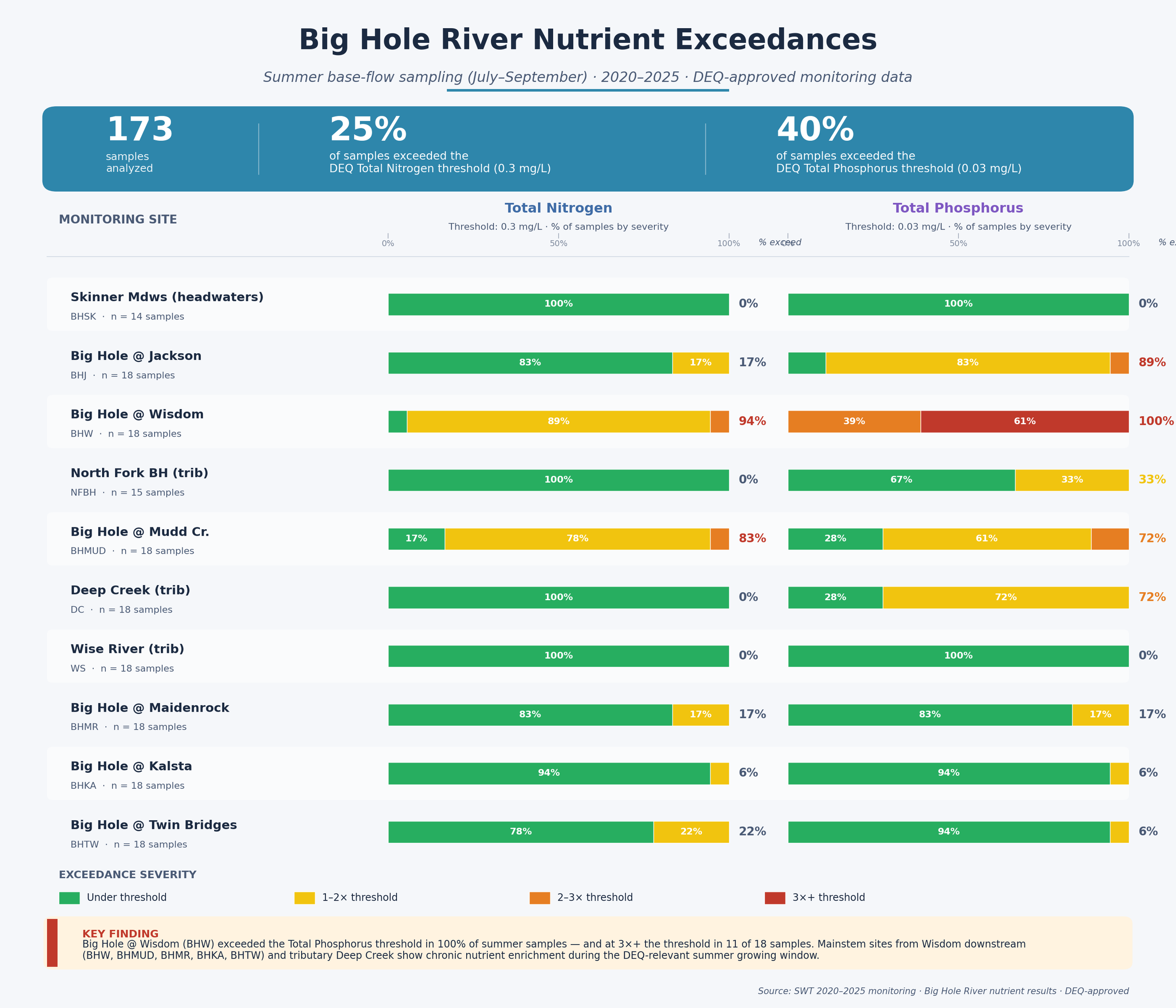
Data results show chronic exceedances in the upper river
Big Hole River - all Month’s sampled - data Results:
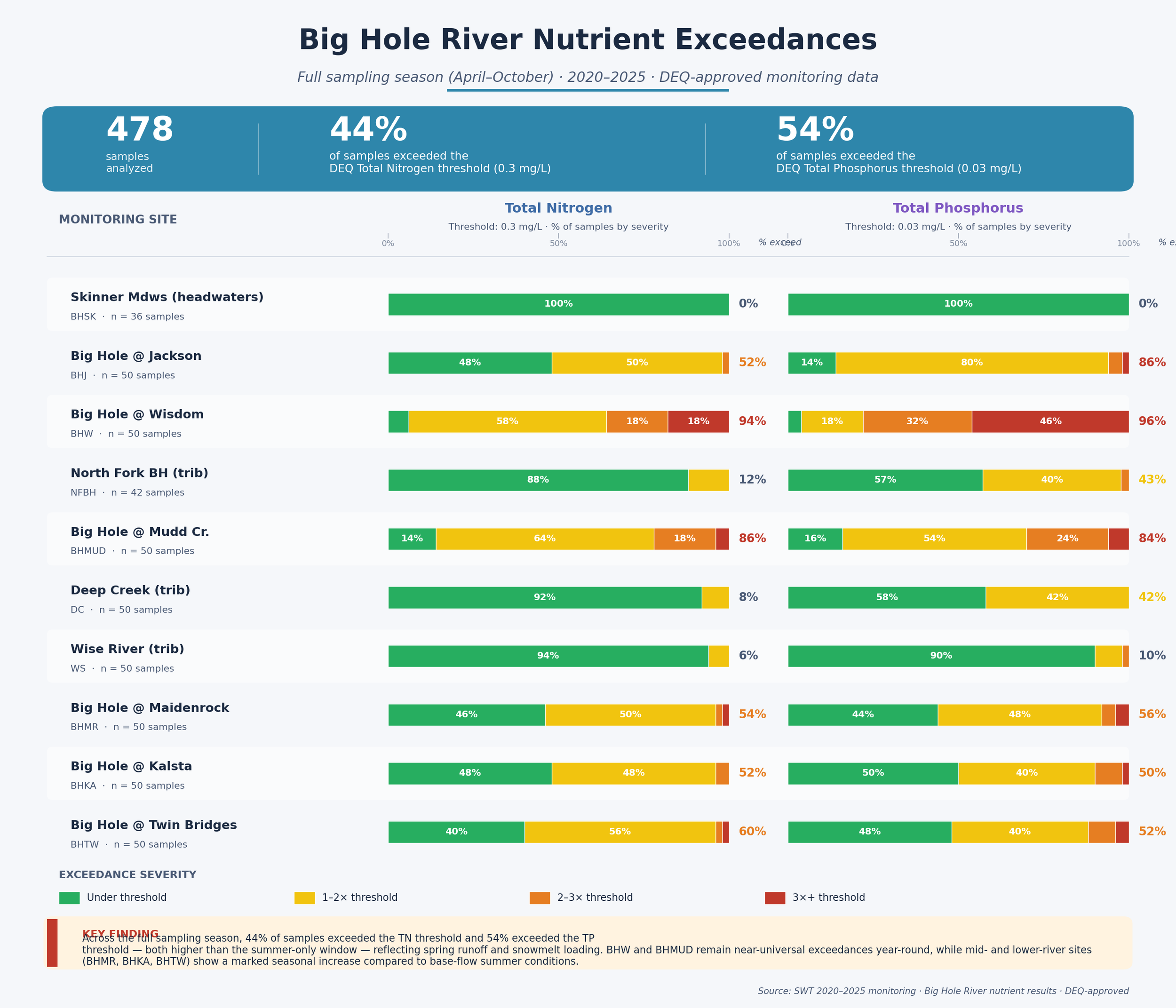
Full season data results (April - October)
To review the full Nutrient Evaluation from Dr. Burkholder, click below:
Thermal Thresholds: montana has fallen behind its neighbors
Perhaps the most quantifiable measure of Montana’s policy drift is its thermal protection of coldwater fisheries. A 2025 review of regional water-quality criteria (Miller, Thermal Thresholds Summary, Save Wild Trout) shows that Montana’s numeric thermal protections lag the regional norm — and in several categories, no species-specific standard exists at all:
• Nonnative trout (rainbow, brown). Montana's hoot-owl angling-restriction trigger does not engage until the maximum daily water temperature reaches 22.8°C (73°F) for three consecutive days — meaning shorter excursions above 73°F generate no protective action at all, and even sustained excursions only restrict afternoon angling rather than treating the temperature as a water quality violation. Idaho, by contrast, protects coldwater aquatic life with an instantaneous maximum of 22°C and a maximum daily average of 19°C, embedded directly in its aquatic-life water quality standards. Wyoming's coldwater fishery designations are likewise embedded in its water quality standards. Washington and Oregon protect salmonid spawning, rearing, and migration habitat using a 7-day average of daily maximums (7-DADMax) of 16–17.5°C and 16–18°C respectively — standards designed around chronic sublethal stress, not just acute mortality.
• Westslope and Yellowstone cutthroat trout. Washington’s salmonid criterion of 17.5°C 7-DADMax is more protective on a chronic-exposure basis than Montana’s current framework. Idaho and Oregon similarly use lower, chronic-form criteria for native salmonids.
• Bull trout. Idaho protects bull trout rearing at a 13°C weekly average and spawning at 9°C. Washington and Oregon use a 12°C 7-DADMax for bull trout habitat. Montana does not currently impose comparably stringent, embedded numeric bull trout criteria at these chronic-exposure levels, despite peer-reviewed thermal tolerance literature supporting them.
• Mountain whitefish and Arctic grayling. Montana has no specific numeric thermal criteria for these species, despite the Upper Big Hole supporting the last fluvial population of Arctic grayling in the contiguous United States — a threatened species whose thermal tolerances are demonstrably narrower than those of brown or rainbow trout.
Why does all this matter?
Because the results from our continuous dataloggers are showing serious temperature problems at several sites.
Temperatures that create excessive strain on trout resilience and metabolic processes.
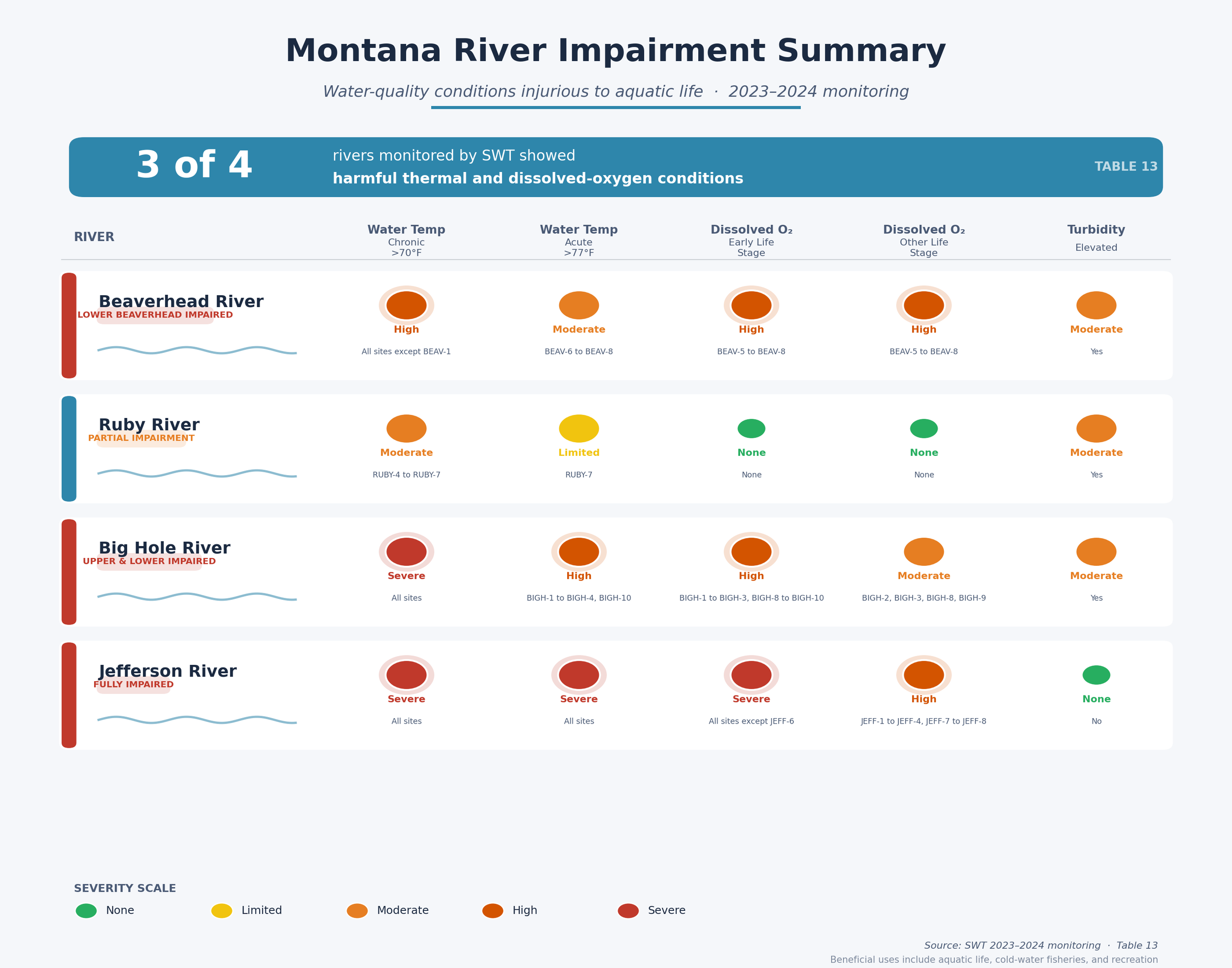
Impairment Summary from the 2023-2024 Jefferson Basin Abiotic Report
The structural problem is not only the numbers. It is the form of the standard. Montana’s framework relies primarily on angling restrictions (hoot-owl closures, season modifications) to prevent catch-and-release mortality once water temperatures climb. Idaho, Wyoming, Washington, and Oregon, by contrast, treat coldwater fisheries as a water quality matter — embedding numeric criteria directly into aquatic-life standards, where they trigger the full machinery of the Clean Water Act: 303(d) listing, TMDL development, antidegradation review, and permit limits on point-source dischargers. Montana’s approach manages fishing pressure on a dying resource. Its neighbors manage the resource itself.
The summary document is helpful for outlining the differences between states' coldwater fisheries protection, specifically this assessment:
A notable difference... is the usage of water quality standards for the protection of aquatic life versus thermal thresholds for restricting angling to prevent aquatic life mortality. Specifically, Montana has a focus on limiting the extraction of aquatic life using stream temperature thresholds to enforce angling restrictions. In contrast, criteria in neighboring states are aimed at broadly supporting salmonid populations beyond merely preventing mortality during angling events by specifically presenting general water temperature standards. (pg 25)
That difference provides an important distinction, because protecting aquatic life according to preferred temp conditions for growth and reproduction rather than a simple focus on avoiding acute mortality thresholds (chronic sublethal conditions affecting respiration, reproduction, and growth rates be damned) gets at the heart of the FWP mission to “steward the fish, wildlife, parks, and recreational resources for the public, now and into the future" and its core value to "...enhance aquatic species and their ecosystems to meet the public’s demand for recreational opportunities and stewardship of aquatic wildlife".
The peer-reviewed and consulting literature is unambiguous on what these gaps cost. Brown trout experience elevated mortality at sustained temperatures above roughly 20°C. Catch-and-release mortality in rainbow trout rises sharply above the same threshold. Power Consulting’s 2015 report The Impact of Climate Change on Montana’s Outdoor Economy estimated that a 30% decline in Montana angling activity by mid-century — well within the range plausible under continued thermal degradation — would correspond to roughly 1,900 jobs lost and $60 million in labor earnings forgone annually, before accounting for downstream effects on outfitting, lodging, and rural tax bases.
Takeaway:
Simply trying to avoid acute mortality does not achieve enhancement of aquatic life as a beneficial use.
It results in coldwater resources stuck in a perpetual state of just barely hanging on, instead of being stewarded for the future.
Montana’s wild trout need protection that at least meets the regional norm.
To read the full Thermal Summary, click below: